Why I built it
Much of empirical social-science research ultimately ends with regression tables, statistical results, and static conclusions. Even when research identifies which government social media communication strategies are associated with better public interaction, those findings are often difficult to explore or apply interactively.
I built WeiboFish to experiment with another possibility: turning empirical findings, NLP models, and real-world social-media data into an interactive research tool.
Rather than attempting to predict public opinion with certainty, WeiboFish provides a pre-publication experimental environment. Users can analyze a draft post, retrieve semantically similar historical cases, and simulate interactions among heterogeneous virtual users to compare possible communication dynamics.
Key numbers
How it works
A continuous research workflow from content measurement and case retrieval to simulation, interpretation, and reporting.
- 01
Measure
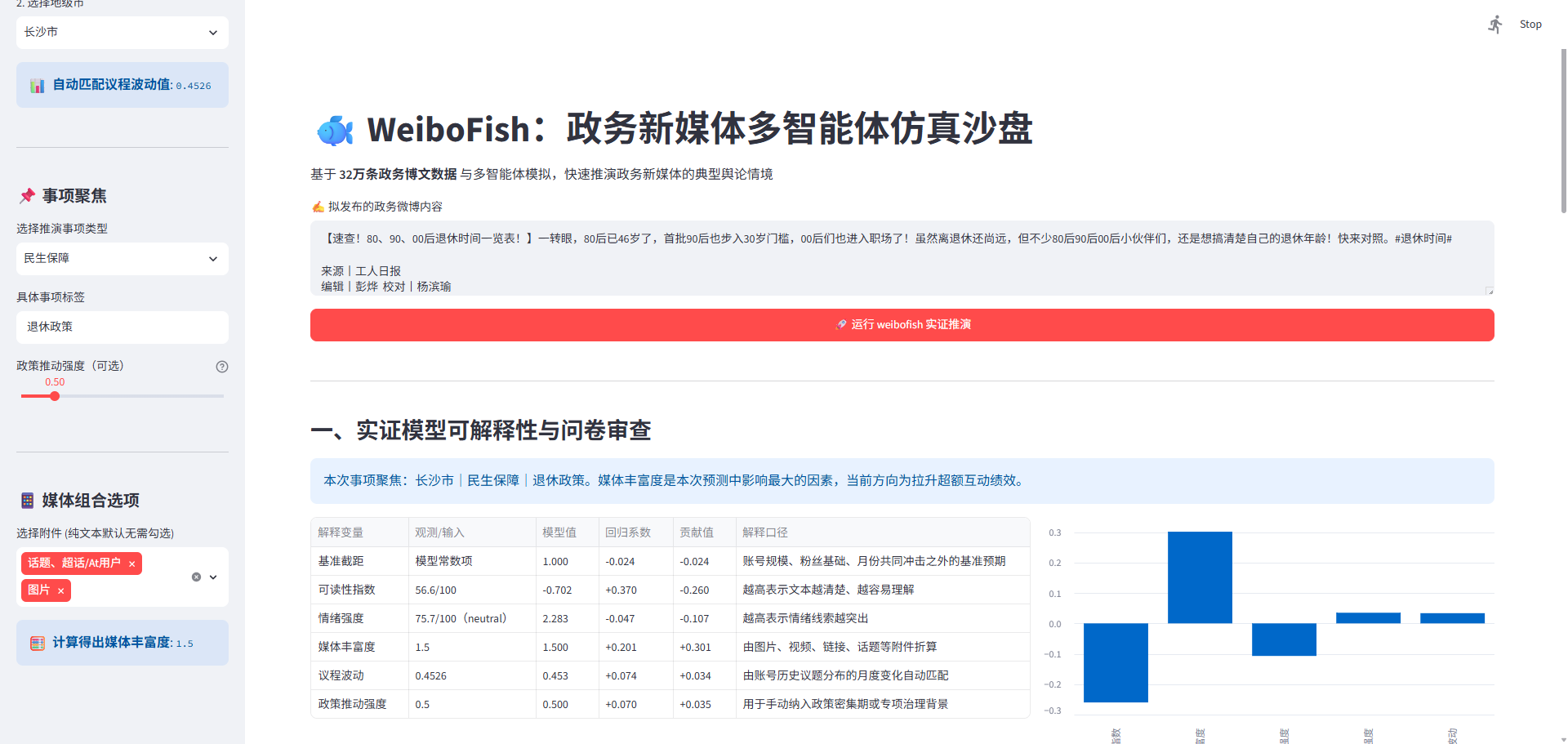
Analyze readability, emotional intensity, media richness, and other interaction-related indicators.
- 02
Retrieve
Use BGE Embedding + FAISS to retrieve semantically similar historical government posts and their real interaction outcomes.
- 03
Simulate
Simulate heterogeneous virtual users' observable interactions and latent attitudes over time.
- 04
Interpret
Visualize exposure, browsing, likes, reposts, comments, temporal dynamics, and interaction-network structure.
- 05
Report
Turn simulation outputs into reconstructed comment threads and analytical summaries for comparison and research demonstration.
Product gallery
Screenshots retain their original interface ratio and text clarity. Select any image to inspect the full-size view.
From Research to Product
WeiboFish did not begin as a standalone AI product in search of a use case.
Its data, metrics, models, and historical cases originated in an empirical research project and were later reorganized into an interactive prototype.
My Role
Independent Product Lead & AI-assisted Builder
Product Design
- Identified the need for quantitative feedback and risk assessment before government social media content publication
- Defined the product objective, user flow, and core feature set
- Owned requirements, feature design, iteration priorities, and acceptance criteria
- Delivered the first working MVP in about one week and continued iterating
Research Translation
- Translated nationwide data, NLP measures, and empirical parameters into product constraints
- Designed the workflow from content measurement and historical-case retrieval to multi-agent simulation, diagnosis, and reporting
- Preserved an interpretable link between research findings and prototype outputs
- Turned empirical research into an interactive, testable research prototype
AI-assisted Implementation
- Used Codex as the primary coding agent
- Evaluated technical options against product requirements
- Reviewed and made targeted modifications to generated code and located basic errors
- Worked with AI agents to implement RAG, semantic retrieval, multi-agent simulation, and interactive features
- Conducted functional testing, iteration, and acceptance
Deployment & Maintenance
- Maintained the GitHub repository and version history
- Configured the cloud server, domain, and HTTPS
- Deployed the prototype with Docker, Linux, and Nginx
- Managed online updates, maintenance, and continued iteration
Methods & Technical Components
Limitations & Responsible Use
WeiboFish is an experimental research prototype. Real-world social-media dynamics are affected by platform algorithms, unexpected events, account reputation, network structure, and broader social sentiment.
Simulation outputs should not be interpreted as deterministic predictions of real public opinion. The platform is intended for pre-publication decision support, scenario comparison, research demonstration, and educational experimentation—not as a substitute for professional monitoring or formal decision-making.Related Research
Government Expression & Public Interaction on Social Media
WeiboFish's data, metrics, and historical case database originated in this empirical study of government social media.
09 / Case Study
Explore WeiboFish
Try the live prototype or review the project's code and version history on GitHub.